BELGRADE, June 9, 2026 – Serbia outperforms the European average in the percentage of women in the ICT sector, but this advantage vanishes on the way to executive positions, where women make up less than 10 percent of management. These are the key findings presented at the seminar “The Code of Success: Women Powering Digital Serbia,” organized at the Ložionica innovation hub before more than 200 leading IT experts and decision-makers by the Serbian IT Association (SITA) and PC Press magazine.
The event was opened by Marko Vučetić, Director of the Serbian IT Association, who highlighted that statistics clearly map out the areas where the industry needs to act.
“Today, the Serbian IT Association brings together 45 leading IT companies that generate as much as 1.4 billion euros in revenue, giving us not only great economic power but also an immense responsibility to actively drive better market standards. Within our association, according to available data, women make up 35 percent of the total workforce, which is a good result, but our long-term focus is to see this percentage continuously grow industry-wide. We advocate for an environment where inclusivity is not viewed merely through statistics, but through the real empowerment of women to take on key decision-making roles,” stated Vučetić.
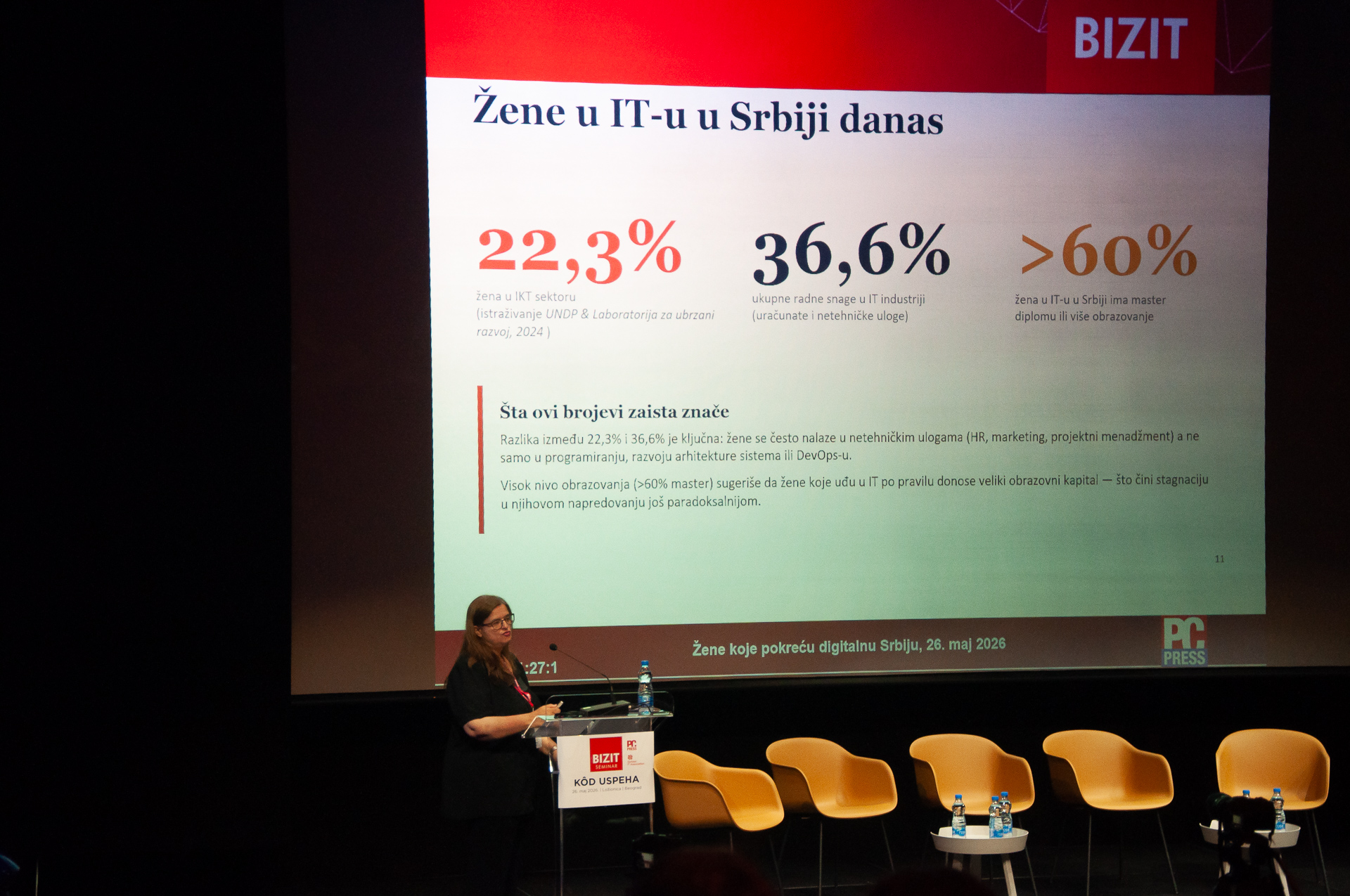
The central part of the event featured a presentation by Prof. Dr. Jelica Protić, who shared sharp statistical data on the position of women in the domestic tech sector:
-
Serbia Ahead of the EU Average: With 22.3% of women in the ICT sector, our country stands above the European average of 18.9%. However, the overall boots-on-the-ground ratio remains 4:1 in favor of men.
-
Educational Capital vs. the Wage Gap: Over 60% of women in the domestic IT sector hold a master’s degree or higher education, yet despite this, the wage gap in comparable positions sits at around 16% in favor of men. The disparity is also stark among high earners—the number of men earning over €2,000 per month is nearly double that of women (28% compared to 15%).
-
The Inverted Pyramid Phenomenon: While women make up 22% of junior roles, their share declines as careers progress—dropping to 17% in management, and falling below 10% in executive (C-level) and directorial roles.
-
Sector Distribution: Women dominate in HR (70%) and UX/UI design (50%), whereas they represent just 7% in system architecture and 9% in DevOps.

Work-life balance challenges were identified as the primary reasons for leaving an IT career (56% of women leave IT for personal/family reasons), alongside a lack of female role models, and tougher career progression through informal male networks and mentorships.
Proposed Solutions for the Industry and Academia
Speakers highlighted concrete steps through lectures and discussions to help both academia and businesses shift these metrics for the better. It was noted that the educational system could play a massive role by actively promoting STEM fields to young girls in schools, introducing mentorship programs, and offering greater flexibility for student-mothers.
On the corporate side, recognized best practices for IT companies include implementing transparent salary ranges, creating structured “Returnship” programs that ease women’s transition back to work after maternity leave, and ensuring greater representation of women on hiring committees.
About the Serbian IT Association (SITA): The Serbian IT Association (SITA) is a leading technology community in Serbia that brings together companies, experts, and decision-makers to advance the domestic digital ecosystem, foster innovation, and build an inclusive and sustainable business environment.